
.svg)
.svg)


We’ll see significant changes across a wide variety of Mass Save incentive amounts in 2025, the best course of action is take advantage of the program rebates as soon as possible.
Key Mass Save Updates for 2026
At a glance: Heat pump rebates have decreased for 2026, with whole-home rebates now at $2,650 per ton (capped at $8,500) and partial-home rebates at $1,125 per ton. Federal tax credits for heat pumps expired at the end of 2025. New EPA refrigerant rules mean systems using R410A refrigerant are no longer eligible for rebates. Rebates are expected to continue declining annually, making 2026 the best remaining time to maximize your savings.
Changes have arrived for Mass Save rebates in 2026—changes that directly impact how much you could save on your heat pump upgrade. If you're considering making the switch to a heat pump, acting this year will help you take advantage of rebates before they decline further. Let's walk you through the key Mass Save changes for 2026.
Mass Save Rebates Have Decreased
As of January 1, 2026, rebates have been reduced from 2025 levels. Whole-home Air Source Heat Pump (ASHP) rebates are now $2,650 per ton, down from $3,000 per ton, with a new maximum cap of $8,500 per home (previously $10,000). Partial-home rebates have also decreased to $1,125 per ton, with the same $8,500 cap.
Mass Save Rebates at a Glance:
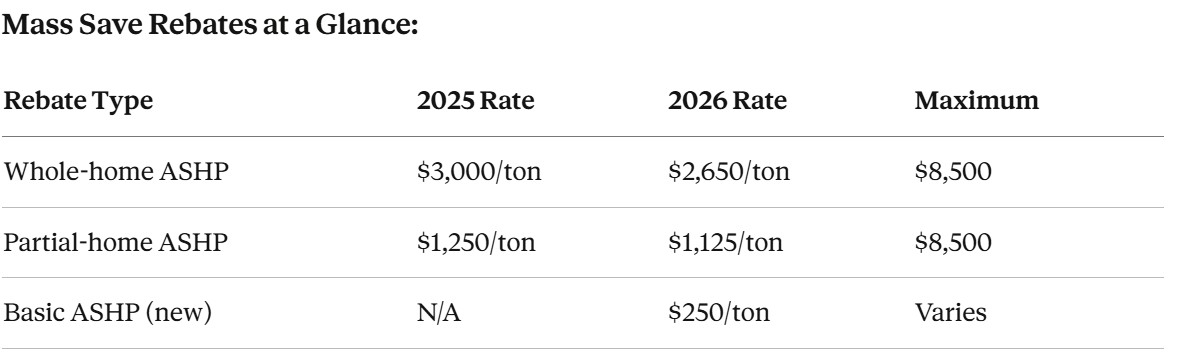
New for 2026: Mass Save has introduced a "Basic Heat Pump Rebate" of $250 per ton for installations that do not replace oil, propane, natural gas, or electric resistance heating—such as new additions or previously unconditioned spaces.
How 2026 Mass Save Rebates Could Impact You:
The reduced rebates affect all homeowners, but smaller households will continue to see less benefit from the per-ton structure. If your home is under 1,200 square feet, your heat pump needs will likely be less than 3 tons, meaning your maximum rebate would be around $7,950 for whole-home installations.
Bonuses still available:
- $500 sizing bonus: For systems properly sized to meet 90-120% of your home's total heating load
- $500 weatherization bonus: For partial-home rebates when weatherization is completed within the qualifying timeframe
New Refrigerant Requirements
A major change for 2026: In compliance with EPA regulations, heat pumps using R410A refrigerant have been removed from the Mass Save Qualified Product List and are no longer eligible for rebates. When selecting your system, ensure it uses next-generation refrigerants like R-32 or R-454B to qualify for incentives.
This is an important consideration when comparing quotes from installers—make sure any proposed equipment uses compliant refrigerants.
Federal Tax Credits Have Expired
The federal Energy Efficient Home Improvement Credit (IRA Section 25C), which allowed homeowners to claim up to $2,000 for qualifying heat pump installations, expired at the end of 2025. Expenditures made in 2026 are no longer eligible for this credit.
This means the combined incentive reduction from 2025 to 2026 could be as much as $3,500 or more when accounting for both the lower Mass Save rebates and the loss of the federal tax credit.
Rebates Are Expected to Decrease Further After 2026
After 2026, incentive amounts for heat pumps are proposed to continue declining annually. The rebate for whole-home Air-Source heat pumps is expected to decrease to approximately $2,500 per ton in 2027, making it important for homeowners to act soon to maximize savings.
How to Calculate Your State Median Income Bracket:
The SMI is scaled based on household size. Here's how it looks for the current fiscal year:
Thresholds for 7-year HEAT Loan eligibility (81%-135% SMI):
- Household of 1: Up to ~$66,400
- Household of 2: Up to ~$86,800
- Household of 3: Up to ~$107,300
- Household of 4: Up to ~$127,700
Households earning 135%-300% SMI: For a 2-person household, this bracket covers incomes from approximately $86K to $192K. These households qualify for 5-year terms at 0% interest, resulting in approximately 40% higher monthly payments compared to 7-year terms.
Households earning above 300% SMI: For a 2-person household making above $192K, loan terms are limited to 3 years at 0% interest. This results in approximately 133% higher monthly payments.
What All These 2026 Mass Save Rebate Changes Mean for Homeowners
Rebates are lower but still significant: While 2026 rebates are reduced from 2025 levels, homeowners can still save thousands on their heat pump installation through Mass Save incentives.
Loans remain affordable for many: The 0% interest HEAT Loan is still available, though shorter terms for higher-income households mean budgeting for higher monthly payments.
Act now if you're ready: With rebate amounts expected to decrease in 2027 and beyond, 2026 is the best remaining year to maximize incentives.
Refrigerant compliance matters: Ensure any system you consider uses R-32 or R-454B refrigerant to remain eligible for rebates.
Why Switch to a Heat Pump?
Heat pumps are an energy-efficient alternative to traditional heating systems like oil, propane, or electric resistance. By upgrading to a heat pump, homeowners can significantly reduce their carbon footprint while benefiting from improved energy efficiency, safety, and comfort. Today's cold climate heat pumps are 2-3x as efficient as a boiler or furnace and many provide efficient heat at outdoor temperatures as low as -15°F.
{{banner-blog-download-guide-blue}}
{{banner-blog-book-consult-green}}
Book Your Free Consultation Today
The 2026 Mass Save program still offers meaningful savings for homeowners ready to make the switch to heat pumps. Whether you're looking to replace an outdated system or make your home more sustainable, now is the time to explore your options before rebates decline further. To take advantage of your rebate, book your free virtual estimate with Tetra today.


.avif)


.jpg)


.jpg)


.jpg)